Tag Archives: Psychology

Meet Your Two Brains: The Wizard and The Lizard

Episode 1 of the Building Bridges To Common Ground Series
4-minute read


Like a lot of people, I used to think that we humans are basically rational creatures who occasionally get emotional. We tend to picture ourselves as generally making logical decisions after carefully weighing evidence and considering our options—although emotions may sometimes interfere with our otherwise sound judgment.

But what if it’s actually the other way around?

An extensive body of neuroscience shows that the vast majority of our decisions are driven mostly by emotional and instinctual responses, which we later justify with logical-sounding explanations. Understanding this fundamental truth about how our brains actually work can transform how we see ourselves and how we interact with others.

Your Two Competing Systems

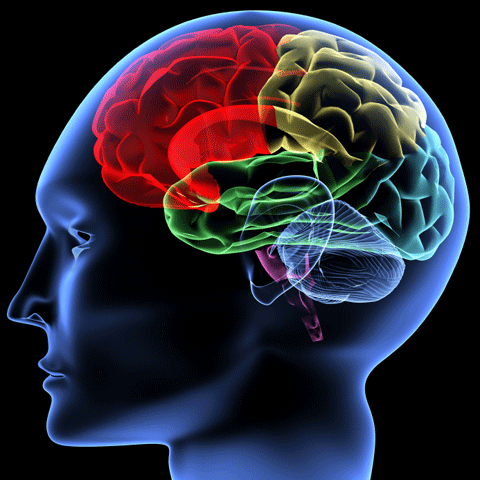
You have two distinct thinking systems that often compete for attention and control: the Lizard Brain and the Wizard Brain.
The Lizard Brain: Your Default Operating System

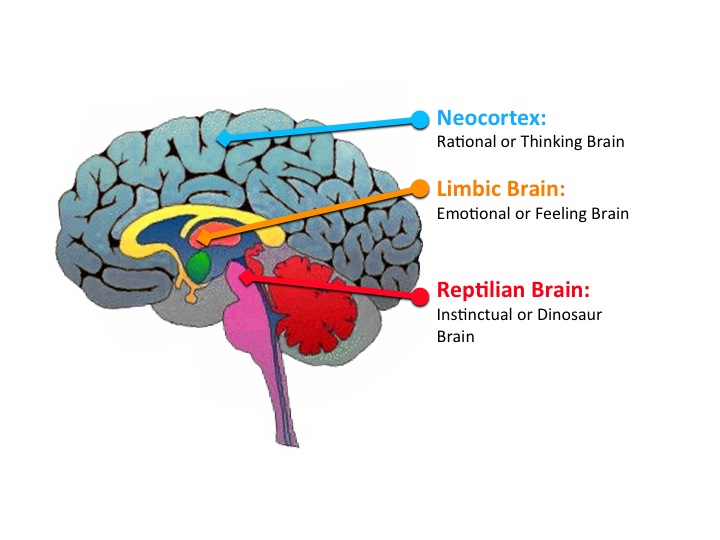
Your Lizard Brain (also called the reptilian or “instinctual brain”) evolved over millions of years with one primary mission: Keep You Alive. It’s constantly scanning your environment for potential threats or rewards, automatically categorizing everything it encounters as:

Fight or flight
  • Safe or dangerous
  • Familiar or unfamiliar
  • Rewarding or threatening

This system operates on emotion and instinct. It’s lightning-fast and energy-efficient. When it detects a potential threat—whether a physical danger or a challenging idea—it triggers immediate defensive reactions.

The problem? Your Lizard Brain can’t tell the difference between a savage predator and an opposing political point of view. Both can trigger the exact same defensive “fight, flight or freeze” reaction in our bodies.

The Wizard Brain: Your Executive Override

Your Wizard Brain, centered in your prefrontal cortex, is a relatively recent evolutionary development. It’s responsible for rational thought, complex analysis, and self-control. It’s what allows you to question your initial reactions, consider multiple perspectives, and make nuanced decisions.

The Wizard Brain is impressive but has significant limitations: it’s relatively slow, requires substantial energy, and often gets overridden when emotions run high. Think of it as a powerful but resource-intensive program that your brain only runs when necessary.

A Surprising Imbalance

Research in cognitive psychology reveals that a substantial majority of our mental processing occurs automatically, outside our conscious awareness. While we’d like to believe our thoughtful analysis drives most of our decisions, studies suggest otherwise.

Our Lizard Brain operates continuously and effortlessly, generating impressions, intuitions, and emotional responses that significantly influence our choices. Meanwhile, our Wizard Brain requires deliberate activation and consumes considerable mental energy.

This imbalance explains why we often make decisions based on emotion and instinct first, then use logical thinking afterward to find supporting evidence that will justify our decisions. And it makes sense, since the Lizard Brain is located right at the top of the brain stem, where all of our sensory input flows into the brain to be processed. The very next stop after that is the emotional center of the brain. It’s not that rational thought plays no role—it’s that it frequently serves to explain and validate what our intuitive brain has already decided.

Think of a person who tells you that they have decided to buy a new car. They’re excited about it, but it’s likely that they will also give you a few reasons for why it’s actually a smart decision. Their old car is getting up there in mileage and the brakes are worn, so it’s probably going to need some expensive repairs soon. That can help make it feel like the new car won’t actually be much more expensive, right? Of course, this is almost never true, but their Wizard Brain is doing its best to help justify what they have already decided they want. This is what we call rationalization–and it happens after the emotional center of our brain has already made a choice. Our brains tend to argue for what we want to be true.

This doesn’t mean we’re hopelessly irrational. Rather, it suggests that understanding the relationship between our intuitive and analytical thinking systems is crucial for better decision-making.

Intelligence vs. Emotional Awareness

You might wonder: Doesn’t intelligence make a difference? Won’t “smarter” people be more likely to use their Wizard Brains?

Surprisingly, conventional intelligence (as measured by IQ or academic achievement) doesn’t necessarily correlate with better decision-making when our emotions are triggered. Studies have shown that highly intelligent people are just as susceptible to emotional reasoning as anyone else—and sometimes even more so, because they can be better at constructing elaborate justifications for their beliefs and developing attacks on other people’s positions.

What seems to matter more is emotional awareness—recognizing when your Lizard Brain has taken control and consciously engaging your Wizard Brain. This skill is closer to what we might call wisdom than intelligence, and it can be developed regardless of your IQ score.

Why This Matters for Bridging Divides

When someone disagrees with us, their position likely isn’t the result of faulty logic— it may be rooted in different emotional responses that their Wizard Brain has rationalized. And of course, we may be doing the same thing to them.

One more important point: Facts alone rarely change minds. This is because facts require your Wizard Brain to process them, but most of the time the Lizard Brain is actually in charge. This isn’t because people are stupid or irrational—it’s because they’re human.

Lizard Wizard

We need both the Lizard and the Wizard to function at our best. But it’s probably better when the Wizard rides the Lizard, rather than the other way around.

The next time you find yourself in an argument, ask yourself: “Which part of my brain is running my show right now? And what might be driving this other person’s responses?”

What do you think? Can recognizing our emotional foundations change how you’ll approach a disagreement? Have you noticed highly intelligent people (maybe even you) who sometimes get trapped in lizard-brain reactions? I’d love to hear your thoughts in the comments below.


Up Next: “Why Stories Beat Facts (almost every time)”


The Starfish Story: one step towards changing the world

You may have heard this one, but I find that it doesn’t hurt to be reminded of it every once in a while.  First let me tell you the story, and then we can talk about it. 

Once upon a time, there was an old man who used to go to the ocean to do his writing. He had a habit of walking on the beach every morning before he began his work. Early one morning, he was walking along the shore after a big storm had passed and found the vast beach littered with starfish as far as the eye could see, stretching in both directions. 

Off in the distance, the old man noticed a small boy approaching.  As the boy walked, he paused every so often and as he grew closer, the man could see that he was occasionally bending down to pick up an object and throw it into the sea.  The boy came closer still and the man called out, “Good morning!  May I ask what it is that you are doing?”

The young boy paused, looked up, and replied “Throwing starfish into the ocean. The tide has washed them up onto the beach and they can’t return to the sea by themselves,” the youth replied. “When the sun gets high, they will die, unless I throw them back into the water.”

The old man replied, “But there must be tens of thousands of starfish on this beach. I’m afraid you won’t really be able to make much of a difference.”

The boy bent down, picked up yet another starfish and threw it as far as he could into the ocean. Then he turned, smiled and said, “It made a difference to that one!”

adapted from The Star Thrower, by Loren Eiseley (1907 – 1977)

We all have the opportunity to help create positive change, but if you’re like me, you sometimes find yourself thinking, “I’m already really busy, and how much of a difference can I really make?”  I think this is especially true when we’re talking about addressing massive social problems like tackling world hunger or finding a cure for cancer, but it pops up all of the time in our everyday lives, as well. So when I catch myself thinking that way, it helps to remember this story.  You might not be able to change the entire world, but at least you can change a small part of it, for someone. 

They say that one of the most common reasons we procrastinate is because we see the challenge before us as overwhelming, and that a good way to counter that is to break the big challenge down into smaller pieces and then take those one at a time–like one starfish at a time.  And to that one starfish, it can make a world of difference.

“A single, ordinary person still can make a difference – and single, ordinary people are doing precisely that every day.”
Chris Bohjalian, Vermont-based author and speaker


Related Post:
Changing Course: How America Got Lost, and How We Can Find Our Way Back Together


Brain Rules: “Chunking” Your Event Into Small Bites – Engaging Event Series #3


Too much information, too little time.
 

You know it—this is certainly one of the biggest challenges for us as we navigate life in the early 21st century.  We have access to (and are bombarded with) a virtually endless stream of info, but with hopelessly limited time to sort through it, process it, reflect upon it and apply it to our own lives.  God knows we’ve been trying, though.  Some years back, USAToday reformatted newspapers (remember those?) so that you could quickly scan dozens of newsbriefs right from the front page—a model  that is imbedded into just about every Internet homepage today.  We shifted from spending much of our days on the phone to scanning our email, then to text messaging, and now lots of us are making do with exchanging ideas in 140 characters or less on Twitter. For bloggers, a rule of thumb suggested by some experts is to keep your posts to three paragraphs or so, to ensure that your readers won’t bail out at the sight of a lengthy article (apparently I’m taking a bit of a chance here!).  TED talks have driven speakers to condense their 1-hour presentations down to 18 minutes.  

This is not really a new concept, however.  It’s basically just another way of delivering more “bang for the buck”, only now it’s being applied to your investment of time and mental capacity.  And we’re gobbling it up, despite the fact that it can be stress-inducing.  Most likely it’s going to get worse; Google CEO Eric Schmidt recently said “Today, more content is created in 48 hours than from the beginning of time until 2003.”  But if just reading this gets your heart beating a little faster, you should know that there is a silver lining in here: if managed properly, this need to limit the size of our information bursts may actually be better for our brains.

A few years ago I heard a Dartmouth professor named Chris Jernstedt speak about his research into how our brains work and learn.  It turns out that our natural attention span is shorter than you might think: the brain has a hard time processing more than 15 minutes of content at one stretch.  He introduced the concept of “chunking”, which refers to the fact that we process and remember information better when we group it into manageable units or chunks.  We have a finite capacity of short-term memory that can hold information in an active, readily available state, but when that memory bank is full, it starts pushing the oldest deposits out in order to make room for new information coming in. The only way we can keep from “losing” a lot of that information is if we use it right away—that’s what transfers the information into our long-term memory so we can go get it later.  We are much better at retaining new ideas and skills if given the chance to consider and try them out before our brain moves on to the next thing.


(fast forward to slide 17 to skip to the main ideas)

Problem is, a lot of the time this doesn’t happen.  And it’s one reason why we tend to tune out long, boring presentations that seem to go on and on, even if they are accompanied by zippy PowerPoint slides.  Now, this doesn’t mean we can’t explore a subject in depth; it just means that it will be more effective if we design an experience where the subject matter is broken up into bite-sized pieces that our brains can finish chewing on before we try to cram in another big fork-full of information.  It’s fine to schedule a 1-hour presentation or breakout session, as long as you “chunk” the material into several coherent segments and periodically give participants the opportunity for personal reflection and—ideally–interaction with others.

Here’s a quick summary of strategies for helping to make sure your program “sticks” with the participants:

  • Identify the most important information, concepts or skills to be delivered.  Leave out the fluff—you don’t need it. 
  • Break the program down into a series of manageable chunks.  Design 10- to 20-minute segments where you will introduce new information and then ask participants to use and apply it in some way.  
  • Build in time for participants to think about how they might relate the information that’s just been presented to their own business or personal lives.  Relevance is what makes it stick.
  • If you can swing it, conclude with an opportunity to reinforce key takeaways.  Refer back to your original goals for the session and, ideally give audience members the opportunity to share their own conclusions with others.

As a bonus, most people will experience this kind of program as being more engaging, more energizing and ultimately, more valuable.  So like Mom used to say, finish chewing your food before taking another bite.  That’s the best way to enjoy a big meal and, apparently, consuming information works pretty much the same way.