Tag Archives: persuasion

6 Expectations to Abandon Before Your Next Difficult Conversation

Episode 5 of the Building Bridges Series
4-minute read


Have you ever been part of a conversation about a difficult topic—politics, religion, parenting approaches, etc.—and watched it quickly spiral into frustration or outright conflict? My guess is that your answer is a resounding yes.

What if I suggested that many of these conversations go sideways not because of what was said, but because of the expectations we had going into them?

The reality is, having a successful conversation where there’s likely to be disagreement (without it becoming stressful or heated) may require you to let go of certain common expectations before you even get started. I got this idea from my experiences with the Braver Angels organization, whose purpose is no less than to  restore the American spirit of working together.

Here are six expectations worth dropping before your next challenging conversation:

1. “I can change their mind.”

This might be the most damaging expectation of all. The truth is, we can’t force anyone to change their core beliefs. The only person you can reliably change is yourself.

When you enter a conversation determined to change someone’s mind, you’re setting yourself up for frustration. Instead, aim to understand their perspective better and perhaps plant seeds that might grow later.

2. “We can agree on the facts and have a logical discussion.”

It seems reasonable to expect that we can agree on basic facts and follow logical progressions. But human brains don’t always work that way.

We all process information through existing belief filters. What seems like an indisputable fact to you might represent a threat to someone else’s entire worldview. Their resistance isn’t necessarily about logic—it’s about preserving their own psychological coherence.

3. “I am right.”

This certainty feels good, but it creates a major barrier to genuine dialogue. The moment we become absolutely certain we’re right about something is often the moment we stop being able to learn anything new.

Try entering conversations with the humility to admit you might be missing something. As they say on the podcast “No Stupid Questions,” you have to commit to the possibility that you might be wrong. This other person may know or have experienced something that you hadn’t ever thought of before.

4. “There will be a winner and a loser.”

Many of us unconsciously approach difficult conversations like debate competitions, where one person will emerge victorious and the other defeated.

Real life isn’t a debate tournament. The most productive conversations often end not with victory but with better understanding. Sometimes we need to let go of the need to win for a while.

5. “We should end up agreeing with each other.”

Agreement is a high bar that often isn’t realistic. A better approach is to focus on understanding why someone sees things differently than you do.

You still might not agree at the end, but at least you’ll know why and so will they. This understanding builds bridges even when consensus isn’t possible.

6. “If I keep an open mind to new ideas, they will too.”

Being open-minded is like being in shape—not everyone exercises regularly. Some people may not be ready to question their assumptions or consider new perspectives, especially in a first conversation.

It’s best to meet people where they are, not where you wish they were. Their openness may grow over time, especially if they see you modeling the curiosity and respect you hope to receive from them.

A Different Approach

Instead of these expectations, try approaching difficult conversations with:

  • Curiosity about how someone else sees the world
  • A willingness to listen, not just talk
  • An assumption that this person may know something that you don’t
  • Respect for the other person’s humanity, even if you don’t agree with them
  • Patience with the process of building understanding

The goal isn’t to eliminate disagreement—that may sound nice, but we won’t ever get there. Instead, the goal can be to disagree better. By abandoning these six expectations, you create space for more productive exchanges, even if you’re talking about challenging topics. And if you can find at least some areas of common ground, that can be first step in finding ways to work together.

Up Next: “How Your Worldview Filters Everything You See”


Confirmation Bias: Why We Usually See What We Expect to See

Episode 3 of the Building Bridges Series
3-minute read


Have you ever wondered why two people can look at exactly the same information and come to completely different conclusions? Or why some people seem immune to facts that contradict what they already believe?

There’s a good chance that this is a result of a fundamental feature of the way our brains operate: Confirmation Bias. When it comes absorbing new information, you can think of this as a sometimes helpful but often troublesome gatekeeper.

What Is Confirmation Bias?

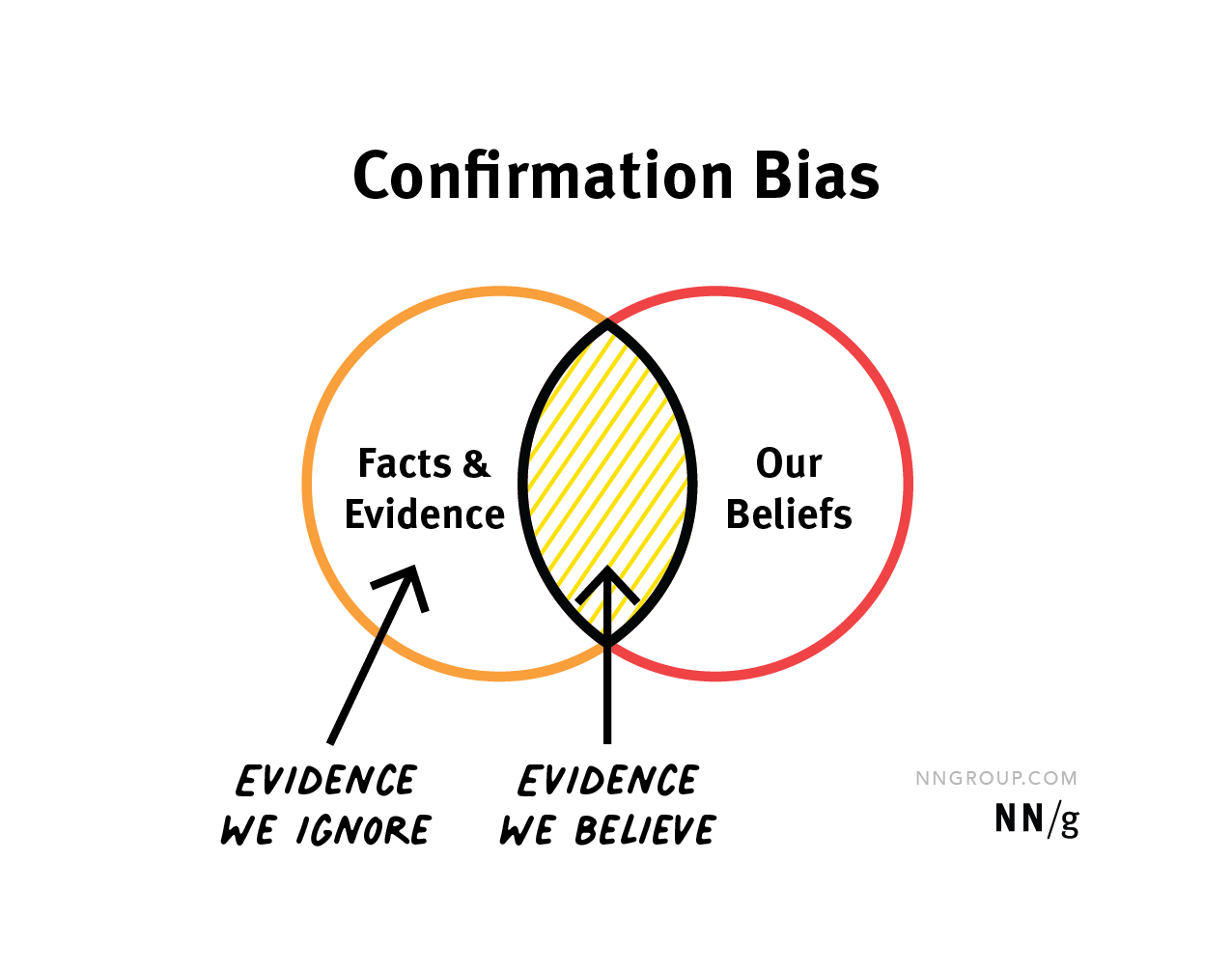
Confirmation bias is our natural tendency to notice, seek out, and remember information that supports what we already believe, while ignoring or dismissing information that contradicts those beliefs.

It’s like wearing glasses that filter reality, allowing you to see only what matches your existing worldview. The problem? We don’t realize we’re wearing these glasses. We believe we’re seeing the full, objective picture.

Your Brain’s Filter System

Your brain processes millions of bits of information every second, but you’re only consciously aware of a tiny fraction of it. To avoid getting overwhelmed, your brain uses shortcuts to decide what deserves your attention.

One of these shortcuts is to prioritize information that confirms your existing beliefs, since that’s much faster and requires a lot less energy. This happens in three key ways:

  1. Selective attention: You naturally notice things that support your beliefs and overlook things that don’t.
  2. Biased interpretation: When faced with ambiguous information, you interpret it in ways that support your existing views.
  3. Selective memory: You remember evidence that confirms your beliefs better than evidence that challenges them.

This isn’t something only “other people” do. We ALL do it, regardless of education level, intelligence, or political leaning.

The “That’s Interesting” vs. “That’s Wrong” Test

Here’s a simple way to spot confirmation bias in action: Pay attention to your immediate reaction when you encounter new information.

If the information seems to support your existing beliefs, you likely think, “That’s interesting!” or “I knew it!” You accept it easily, without much scrutiny.

If the information contradicts your beliefs, your first thought is probably closer to, “That’s wrong!” or “That can’t be right.” You immediately look for flaws or reasons to dismiss it, which often includes questioning the credibility of the information source.

The stronger your reaction, the more your confirmation machine is probably at work.

Why It’s So Hard to Overcome

Our confirmation machine isn’t just a minor glitch—it’s a powerful force that shapes how we see the world. And there are several reasons it’s so difficult to overcome:

  1. It operates largely unconsciously. We don’t realize we’re filtering information.
  2. It feels good to have our beliefs confirmed. Being right gives us a small dopamine reward.
  3. Challenging our beliefs can feel threatening, triggering our brain’s defense mechanisms.
  4. We’re surrounded by people who often share and reinforce our biases.
  5. If you engage in social media, powerful algorithms are restricting what you’ll see to content that you’ve already shown an interest in.

Remember when I mentioned in my post about our two brains that the Lizard Brain plays a leading role in our decision-making? Well, confirmation bias is one of its favorite tools.

Why This Matters

Confirmation bias isn’t just an interesting psychological quirk—it’s a key reason we’re so divided on important issues. When we only see evidence that supports our existing beliefs, we drift further apart instead of finding common ground.

Understanding confirmation bias doesn’t mean you’ll suddenly be free from it. But awareness is the first step. The next time you feel strongly about something, try asking yourself: “Am I seeing the full picture here, or is my confirmation machine filtering my view of reality?”

What do you think? Have you caught your confirmation machine in action recently? Which beliefs or stories might your brain be working to protect? You’re invited to add your thoughts below.


Up Next:
The Power (and The Dark Side) of Tribes


Why Stories Beat Facts (Almost Every Time)

Episode 2 of the Building Bridges Series
4-minute read


Have you ever tried to change someone’s mind with facts, statistics, and logical arguments, only to watch them completely ignore your evidence? It’s not just frustrating—it’s puzzling. If facts are true, why don’t they convince people?

The answer lies in the power of stories.

The Photo That Changed Refugee Policy

In 2015, a single photograph of two-year-old Alan Kurdi, who drowned while his family tried to flee Syria, sparked a dramatic international response to the refugee crisis. This one image accomplished what thousands of news articles containing statistics about multitudes of refugees couldn’t do—it moved people to action.

Charitable donations skyrocketed. Policies changed. Public opinion shifted dramatically.

Why did one image of one child have more impact than statistics about 6.7 million Syrian refugees? Because the photo told a story that statistics simply can’t.

How Our Brains Process Stories vs. Facts

Our brains evolved to think in stories, not spreadsheets. For most of human history, knowledge was passed down through storytelling. As a result, our brains are wired to pay special attention to narratives.

When we hear a story:

  • Our brains release oxytocin, the chemical that promotes trust and empathy
  • Multiple areas of our brain activate simultaneously (language, sensory, emotional)
  • We mentally insert ourselves into the narrative, almost like a simulation
  • We remember the information far longer than isolated facts

Facts and statistics, by contrast, typically activate only our analytical brain regions. They don’t trigger the same emotional engagement, and they’re much harder to remember.

Why Stories Are “Sticky”

Think about the last time you tried to remember a list of facts versus a good story. Which stayed with you longer?

Stories At Work

Stories are “sticky” because they:

  • Create emotional connections
  • Provide context and meaning
  • Follow patterns our brains recognize
  • Create vivid mental images
  • Simplify complex information

A good story feels true, regardless of whether it actually is. And that’s exactly what makes stories so powerful—and sometimes dangerous.

When Stories Override Facts

A compelling narrative can override even the most solid facts. This happens because:

  1. We process stories first: Our Lizard Brain (the emotional, instinctual part) processes stories before our Wizard Brain (the rational, analytical part) can evaluate the facts.
  2. Stories create meaning: We inherently seek meaning, and stories provide ready-made frameworks for making sense of the world.
  3. Stories reinforce identity: We embrace stories that confirm our existing beliefs and group memberships.

This means that when facts contradict a story we believe in, we’re more likely to reject the facts than to abandon the story.

Harnessing the Power of Stories

Lots of smart people believe that if other people just knew the facts that I know, they would naturally agree with me. But if you’re interested in persuading someone to your point of view, that’s probably a waste of time.

If you want to be persuasive, facts alone won’t cut it. You need to frame those facts within a meaningful story. The most effective approach combines both:

  • Stories to engage emotions and create meaning
  • Facts to provide substance and credibility

When Martin Luther King Jr. said, “I have a dream,” he didn’t just list statistics or reasons for why we should address inequality—he told a vivid story about a better future that people could see themselves in.

Why This Matters

Understanding the power of stories helps explain why we’re so divided on many issues despite having access to the same information. It’s not just about facts—it’s about the different stories we use to make sense of those facts.

The next time you find yourself frustrated that someone won’t accept what seems like an obvious truth, ask yourself: What story are they living in? And how might I connect my facts to a story that resonates with their values and experiences? That may be what it takes to get them to hear what you’re really saying.

Can you give a personal example of when hearing a story changed your mind about something important? Have you noticed yourself rejecting facts that contradicted a narrative you already believed in? You’re invited to add your thoughts below.


Up Next:
Confirmation Bias: Why We Usually See What We Expect To See”