Tag Archives: outcomes

Events 2.0: The 4 Secrets of Fully Engaging Your Attendees

Yes–I’m going to share some secrets with you!  So remember, this is all just between me and you and your colleagues, Twitter followers, LinkedIn connections, Facebook friends/fans, kids, neighbors and anyone else you feel like chatting up.  Of course then it won’t be much of a secret, but that’s okay with me.  The more, the merrier!

But let’s start with a question: What is it that makes great live events better than just getting the same content some other way?  Think of some examples–like the difference between a truly memorable dining experience and the thought of just having the meal delivered to your home or hotel room. Or watching a DVD of a music festival compared to actually being in the middle of it all.  Or reading the minutes of a business meeting vs. participating in it.  How about watching a well-produced YouTube video of a keynote speaker instead of being there?  (Hmm…I bet that last one was not so obvious. But you get my point.) Why do I suggest that the last example is the weakest?  Don’t get me wrong, there are plenty of dynamic and inspiring keynote speakers out there.  But the question is: what do you really get out of the experience of attending an event that can’t be substituted with some kind of copy? 

For some reason, this reminds me of that term “Web 2.0”.  Now, for those of you who haven’t been indoctrinated to this terminology yet, Web 2.0 refers to the second “version” of what we call the Internet.  If you’re old enough to remember as far back as the Clinton presidency (yes, that includes you, Millenials), Web 1.0 was pretty much a new form of one-way information distribution.  When you visited someone’s webpage, you could read whatever information they had prepared for you, sort of like an online brochure.  Heck—they even had photos and stuff.  But it was pretty much a static experience; you viewed it and moved on.  There is still tons of Web 1.0 content out there, and it’s not likely to go away. It’s flexible, convenient and it definitely serves a purpose.

Not too many years later, Web 2.0 took things to a different level: now, instead of being limited to whatever the webmaster of each site puts on display for you, much of what you see on the Internet is “user-generated” content—and the “users” are us.  Pretty big paradigm shift, actually.  Easiest example?  Facebook. Think about how much of what you see on Facebook has been created by Mark Zuckerberg and the massive staff down at FB Headquarters.  Other than the ads on the sidebar, the correct answer is “very little”.  It’s just a shell created in order to allow people to share their knowledge and creative ideas.  By definition, every social media tool does pretty much the same thing.

So what is Events 2.0?  Same idea, basically.  Any time you go to an event and just sit there and take it in, you’re in Event 1.0 mode. Nothing wrong with that necessarily; you can still enjoy and maybe learn a few things from it.  But take it up to V2.0 and now the participants are not only involved, they’re actually contributing much of the content.  And that’s engaging—just as much as going to that amazing restaurant or contributing your ideas and solutions at a business conference.  But like Facebook, someone has to design the structure of the event so that it will get people engaged in the first place. And that’s where the secrets come in!

It doesn’t matter whether you’re a sponsor trying to build relationships with your target clientele, or a corporate trainer bent on raising the skill level of your employees, or an activist trying to inspire people to your cause.  To fully-engage your audience, you’ll need to build these four components into the experience you provide:
   

  1. THE HOOK. To get people engaged, first you need something that initially attracts their attention and draws them in.  This doesn’t just distract them; it also gets them into a receptive state by shifting their attention, so they can leave behind whatever else they were focused on before.  A slightly goofy (but effective) version of this: Flash Mobs.  Take a look at the example below and see what I mean. Notice how the “attendees” respond towards the end.
     
  2. CONTENT RULES!  Of course, you need to present something that’s relevant or otherwise fascinating to this particular audience; otherwise, their attention will quickly move on.  Ideally you’ll have something that answers a question, need or opportunity they have or–even better–introduces them to one they didn’t know they had.  In any case, none of these secrets apply if you don’t have something that will be of significant value to your audience.  So plan on spending a big chunk of your time on this one. Otherwise, none of this matters.
     
  3. DESIGN FOR INTERACTION.  This is really the Events 2.0 part. Getting someone’s attention and delivering fresh content is just getting started: you also want to create an experience where everyone needs to participate on some level, whether it’s physically, intellectually, emotionally, or all three.  That’s the main thing that interactive events can provide that can’t be substituted by one-way communication.  Put people in a situation they’ve never been in before.  Provide the opportunity to experience and respond to something new and learn from not only the “expert” presenters, but from each other. This is the power of bringing people together. In the end, engaging experiences usually leave us changed in some way, but it doesn’t happen by itself–you need to create the context.  And remember that in many cases, your presenters will not have the skills and experience to create this, so you may have to help (or get help). 
     
  4. CLOSE THE DEAL.  Here’s the Big Finish: it’s not enough to get people thinking.  In order to convert the event experience into useful take-aways, it’s critical to build in time for participants to individually process, reflect on and plan how they might use these new ideas and experiences.  This is the real work, but it’s the part that will lead to concrete results.  People need some time to think on their own, but it can help to provide the opportunity for discussion, collaboration or even hands-on group activity. We know enough about how our brains function to expect that, without this step, most of what we’ve encountered during the event will dissipate fairly quickly.  This is also the time for committing people to action, to ensure that the event has a lasting impact.

If any of these steps is missing from the design of your experience, you’re probably stuck back in the time of Events 1.0.  And I would bet that your event is not getting the impact it could, or should. 

In future posts, I’ll be expanding and providing specific examples of how people are really applying these principles to take their events up a notch and you’ll have the opportunity to share your own stories and secrets.  For now, feel free to leave a comment about anything that this post brought to mind!

Brain Rules: “Chunking” Your Event Into Small Bites – Engaging Event Series #3


Too much information, too little time.
 

You know it—this is certainly one of the biggest challenges for us as we navigate life in the early 21st century.  We have access to (and are bombarded with) a virtually endless stream of info, but with hopelessly limited time to sort through it, process it, reflect upon it and apply it to our own lives.  God knows we’ve been trying, though.  Some years back, USAToday reformatted newspapers (remember those?) so that you could quickly scan dozens of newsbriefs right from the front page—a model  that is imbedded into just about every Internet homepage today.  We shifted from spending much of our days on the phone to scanning our email, then to text messaging, and now lots of us are making do with exchanging ideas in 140 characters or less on Twitter. For bloggers, a rule of thumb suggested by some experts is to keep your posts to three paragraphs or so, to ensure that your readers won’t bail out at the sight of a lengthy article (apparently I’m taking a bit of a chance here!).  TED talks have driven speakers to condense their 1-hour presentations down to 18 minutes.  

This is not really a new concept, however.  It’s basically just another way of delivering more “bang for the buck”, only now it’s being applied to your investment of time and mental capacity.  And we’re gobbling it up, despite the fact that it can be stress-inducing.  Most likely it’s going to get worse; Google CEO Eric Schmidt recently said “Today, more content is created in 48 hours than from the beginning of time until 2003.”  But if just reading this gets your heart beating a little faster, you should know that there is a silver lining in here: if managed properly, this need to limit the size of our information bursts may actually be better for our brains.

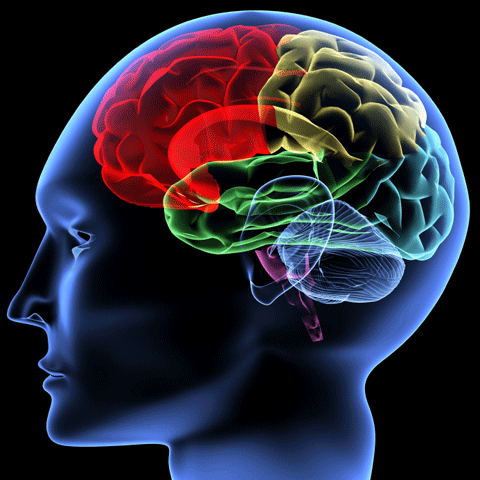
A few years ago I heard a Dartmouth professor named Chris Jernstedt speak about his research into how our brains work and learn.  It turns out that our natural attention span is shorter than you might think: the brain has a hard time processing more than 15 minutes of content at one stretch.  He introduced the concept of “chunking”, which refers to the fact that we process and remember information better when we group it into manageable units or chunks.  We have a finite capacity of short-term memory that can hold information in an active, readily available state, but when that memory bank is full, it starts pushing the oldest deposits out in order to make room for new information coming in. The only way we can keep from “losing” a lot of that information is if we use it right away—that’s what transfers the information into our long-term memory so we can go get it later.  We are much better at retaining new ideas and skills if given the chance to consider and try them out before our brain moves on to the next thing.


(fast forward to slide 17 to skip to the main ideas)

Problem is, a lot of the time this doesn’t happen.  And it’s one reason why we tend to tune out long, boring presentations that seem to go on and on, even if they are accompanied by zippy PowerPoint slides.  Now, this doesn’t mean we can’t explore a subject in depth; it just means that it will be more effective if we design an experience where the subject matter is broken up into bite-sized pieces that our brains can finish chewing on before we try to cram in another big fork-full of information.  It’s fine to schedule a 1-hour presentation or breakout session, as long as you “chunk” the material into several coherent segments and periodically give participants the opportunity for personal reflection and—ideally–interaction with others.

Here’s a quick summary of strategies for helping to make sure your program “sticks” with the participants:

  • Identify the most important information, concepts or skills to be delivered.  Leave out the fluff—you don’t need it. 
  • Break the program down into a series of manageable chunks.  Design 10- to 20-minute segments where you will introduce new information and then ask participants to use and apply it in some way.  
  • Build in time for participants to think about how they might relate the information that’s just been presented to their own business or personal lives.  Relevance is what makes it stick.
  • If you can swing it, conclude with an opportunity to reinforce key takeaways.  Refer back to your original goals for the session and, ideally give audience members the opportunity to share their own conclusions with others.

As a bonus, most people will experience this kind of program as being more engaging, more energizing and ultimately, more valuable.  So like Mom used to say, finish chewing your food before taking another bite.  That’s the best way to enjoy a big meal and, apparently, consuming information works pretty much the same way.


“Are we making any difference?” Engaging Events Series, Episode 2

What can an event planner learn from a couple of physics professors? 

In his book What the best college teachers do,  Ken Bain tells the story of two physics professors at Arizona State University who wanted to find out if all of the time and effort they put into planning and delivering their courses was really making any difference in the way their students thought about things.  So they set up a very simple experiment: they would choose one fundamental physics concept and measure whether their physics course made a significant impact.  They decided to focus on the principles of “motion” and their students’ understanding of how motion actually works.  They pre-tested their students, did their normal 15-week semester gig and then re-tested everyone at the end.  And guess what? They found that, despite all of the time and effort expended by all, when it was all over their students thought about motion pretty much the same way as they did before they took the course. 

As a professional trainer and college professor myself, that story scared me half to death.  If you’re in the business of planning events, you should be, too.  Because it suggests that much–maybe even most–of the event experiences we create (and a classroom is definitely an event) may not be making much of a lasting impact and, if that’s the case, then we’re wasting a whole lot more of our time than we are aware of–not to mention forfeiting tremendous opportunities to make a meaningful difference in people’s lives while we have them gathered together. 

What can we do to help ensure we’re having an impact? Well, it appears that one key element of effective event experience design is a variation on the “less is more” rule: make sure you’re focusing on just a very few critical points or objectives—or maybe even just one.    Of course, this requires some consideration of what your most important outcomes are.  What do you want to be different once the event has concluded?  Which goals are must-haves, and which are just nice-to-haves?

Now back to that physics class: one lesson learned, according to Ken Bain, is that it’s better to focus on just two or three main concepts or competencies and hammer the hell out of them, and not worry so much about covering everything in detail.  Often the mistake we make is to try to cover too many bases at once, because we’re afraid of leaving out something important.   In the case of a college course, this can take the shape of trying to get to the end of the textbook before the semester is over, even if it means that we don’t fully lock in the most important ideas or skills along the way.  There’s nothing wrong with accomplishing multiple objectives at the same time, but not if it means failing to nail the most important ones.

We live in a world where it feels like there is never enough time to do what we need to do.  But remember that old time management adage: “there’s always enough time for the things that are most important.”  The next time you’re planning an event program or experience, don’t worry too much about doing as many things as you can with the time you’re allowed.  Instead, start by making sure you get the most important outcomes really right.  Because in the end, that’s what will make it worth the time and money you’re investing!