Tag Archives: human behavior

Why Stories Beat Facts (Almost Every Time)

Episode 2 of the Building Bridges Series
4-minute read


Have you ever tried to change someone’s mind with facts, statistics, and logical arguments, only to watch them completely ignore your evidence? It’s not just frustrating—it’s puzzling. If facts are true, why don’t they convince people?

The answer lies in the power of stories.

The Photo That Changed Refugee Policy

In 2015, a single photograph of two-year-old Alan Kurdi, who drowned while his family tried to flee Syria, sparked a dramatic international response to the refugee crisis. This one image accomplished what thousands of news articles containing statistics about multitudes of refugees couldn’t do—it moved people to action.

Charitable donations skyrocketed. Policies changed. Public opinion shifted dramatically.

Why did one image of one child have more impact than statistics about 6.7 million Syrian refugees? Because the photo told a story that statistics simply can’t.

How Our Brains Process Stories vs. Facts

Our brains evolved to think in stories, not spreadsheets. For most of human history, knowledge was passed down through storytelling. As a result, our brains are wired to pay special attention to narratives.

When we hear a story:

  • Our brains release oxytocin, the chemical that promotes trust and empathy
  • Multiple areas of our brain activate simultaneously (language, sensory, emotional)
  • We mentally insert ourselves into the narrative, almost like a simulation
  • We remember the information far longer than isolated facts

Facts and statistics, by contrast, typically activate only our analytical brain regions. They don’t trigger the same emotional engagement, and they’re much harder to remember.

Why Stories Are “Sticky”

Think about the last time you tried to remember a list of facts versus a good story. Which stayed with you longer?

Stories At Work

Stories are “sticky” because they:

  • Create emotional connections
  • Provide context and meaning
  • Follow patterns our brains recognize
  • Create vivid mental images
  • Simplify complex information

A good story feels true, regardless of whether it actually is. And that’s exactly what makes stories so powerful—and sometimes dangerous.

When Stories Override Facts

A compelling narrative can override even the most solid facts. This happens because:

  1. We process stories first: Our Lizard Brain (the emotional, instinctual part) processes stories before our Wizard Brain (the rational, analytical part) can evaluate the facts.
  2. Stories create meaning: We inherently seek meaning, and stories provide ready-made frameworks for making sense of the world.
  3. Stories reinforce identity: We embrace stories that confirm our existing beliefs and group memberships.

This means that when facts contradict a story we believe in, we’re more likely to reject the facts than to abandon the story.

Harnessing the Power of Stories

Lots of smart people believe that if other people just knew the facts that I know, they would naturally agree with me. But if you’re interested in persuading someone to your point of view, that’s probably a waste of time.

If you want to be persuasive, facts alone won’t cut it. You need to frame those facts within a meaningful story. The most effective approach combines both:

  • Stories to engage emotions and create meaning
  • Facts to provide substance and credibility

When Martin Luther King Jr. said, “I have a dream,” he didn’t just list statistics or reasons for why we should address inequality—he told a vivid story about a better future that people could see themselves in.

Why This Matters

Understanding the power of stories helps explain why we’re so divided on many issues despite having access to the same information. It’s not just about facts—it’s about the different stories we use to make sense of those facts.

The next time you find yourself frustrated that someone won’t accept what seems like an obvious truth, ask yourself: What story are they living in? And how might I connect my facts to a story that resonates with their values and experiences? That may be what it takes to get them to hear what you’re really saying.

Can you give a personal example of when hearing a story changed your mind about something important? Have you noticed yourself rejecting facts that contradicted a narrative you already believed in? You’re invited to add your thoughts below.


Up Next:
Confirmation Bias: Why We Usually See What We Expect To See”

Meet Your Two Brains: The Wizard and The Lizard

Episode 1 of the Building Bridges To Common Ground Series
4-minute read


Like a lot of people, I used to think that we humans are basically rational creatures who occasionally get emotional. We tend to picture ourselves as generally making logical decisions after carefully weighing evidence and considering our options—although emotions may sometimes interfere with our otherwise sound judgment.

But what if it’s actually the other way around?

An extensive body of neuroscience shows that the vast majority of our decisions are driven mostly by emotional and instinctual responses, which we later justify with logical-sounding explanations. Understanding this fundamental truth about how our brains actually work can transform how we see ourselves and how we interact with others.

Your Two Competing Systems

You have two distinct thinking systems that often compete for attention and control: the Lizard Brain and the Wizard Brain.

The Lizard Brain: Your Default Operating System

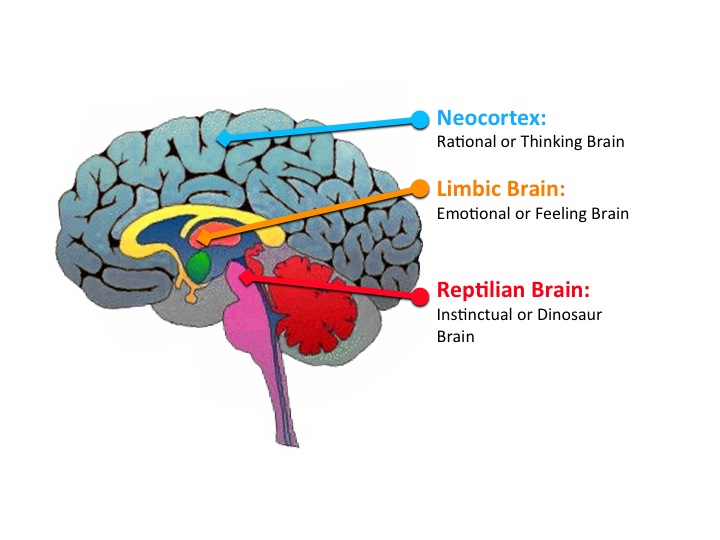
Your Lizard Brain (also called the reptilian or “instinctual brain”) evolved over millions of years with one primary mission: Keep You Alive. It’s constantly scanning your environment for potential threats or rewards, automatically categorizing everything it encounters as:

Fight or flight
  • Safe or dangerous
  • Familiar or unfamiliar
  • Rewarding or threatening

This system operates on emotion and instinct. It’s lightning-fast and energy-efficient. When it detects a potential threat—whether a physical danger or a challenging idea—it triggers immediate defensive reactions.

The problem? Your Lizard Brain can’t tell the difference between a savage predator and an opposing political point of view. Both can trigger the exact same defensive “fight, flight or freeze” reaction in our bodies.

The Wizard Brain: Your Executive Override

Your Wizard Brain, centered in your prefrontal cortex, is a relatively recent evolutionary development. It’s responsible for rational thought, complex analysis, and self-control. It’s what allows you to question your initial reactions, consider multiple perspectives, and make nuanced decisions.

The Wizard Brain is impressive but has significant limitations: it’s relatively slow, requires substantial energy, and often gets overridden when emotions run high. Think of it as a powerful but resource-intensive program that your brain only runs when necessary.

A Surprising Imbalance

Research in cognitive psychology reveals that a substantial majority of our mental processing occurs automatically, outside our conscious awareness. While we’d like to believe our thoughtful analysis drives most of our decisions, studies suggest otherwise.

Our Lizard Brain operates continuously and effortlessly, generating impressions, intuitions, and emotional responses that significantly influence our choices. Meanwhile, our Wizard Brain requires deliberate activation and consumes considerable mental energy.

This imbalance explains why we often make decisions based on emotion and instinct first, then use logical thinking afterward to find supporting evidence that will justify our decisions. And it makes sense, since the Lizard Brain is located right at the top of the brain stem, where all of our sensory input flows into the brain to be processed. The very next stop after that is the emotional center of the brain. It’s not that rational thought plays no role—it’s that it frequently serves to explain and validate what our intuitive brain has already decided.

Think of a person who tells you that they have decided to buy a new car. They’re excited about it, but it’s likely that they will also give you a few reasons for why it’s actually a smart decision. Their old car is getting up there in mileage and the brakes are worn, so it’s probably going to need some expensive repairs soon. That can help make it feel like the new car won’t actually be much more expensive, right? Of course, this is almost never true, but their Wizard Brain is doing its best to help justify what they have already decided they want. This is what we call rationalization–and it happens after the emotional center of our brain has already made a choice. Our brains tend to argue for what we want to be true.

This doesn’t mean we’re hopelessly irrational. Rather, it suggests that understanding the relationship between our intuitive and analytical thinking systems is crucial for better decision-making.

Intelligence vs. Emotional Awareness

You might wonder: Doesn’t intelligence make a difference? Won’t “smarter” people be more likely to use their Wizard Brains?

Surprisingly, conventional intelligence (as measured by IQ or academic achievement) doesn’t necessarily correlate with better decision-making when our emotions are triggered. Studies have shown that highly intelligent people are just as susceptible to emotional reasoning as anyone else—and sometimes even more so, because they can be better at constructing elaborate justifications for their beliefs and developing attacks on other people’s positions.

What seems to matter more is emotional awareness—recognizing when your Lizard Brain has taken control and consciously engaging your Wizard Brain. This skill is closer to what we might call wisdom than intelligence, and it can be developed regardless of your IQ score.

Why This Matters for Bridging Divides

When someone disagrees with us, their position likely isn’t the result of faulty logic— it may be rooted in different emotional responses that their Wizard Brain has rationalized. And of course, we may be doing the same thing to them.

One more important point: Facts alone rarely change minds. This is because facts require your Wizard Brain to process them, but most of the time the Lizard Brain is actually in charge. This isn’t because people are stupid or irrational—it’s because they’re human.

Lizard Wizard

We need both the Lizard and the Wizard to function at our best. But it’s probably better when the Wizard rides the Lizard, rather than the other way around.

The next time you find yourself in an argument, ask yourself: “Which part of my brain is running my show right now? And what might be driving this other person’s responses?”

What do you think? Can recognizing our emotional foundations change how you’ll approach a disagreement? Have you noticed highly intelligent people (maybe even you) who sometimes get trapped in lizard-brain reactions? I’d love to hear your thoughts in the comments below.


Up Next: “Why Stories Beat Facts (almost every time)”


Changing Course: How America Got Lost, and How We Can Find Our Way Back Together

An Introduction to the Building Bridges To Common Ground Series

If we’re going to have a shot at living together peacefully, we need to understand each other.
— Jonathan Haidt


Ever since I was a kid, I’ve always been interested in how things work (or sometimes, don’t work). But back in 2016, I was especially puzzled about a phrase I kept hearing people say during the US Presidential race between Donald Trump and Hillary Clinton. It was this:
“How could you possibly vote for (fill in the blank)?”.
It didn’t matter which side they were on–everyone had the same incredulous, confused tone in their voices.

Now, I know there have always been disagreements about who to vote for–that’s part of how democracy works. But what struck me then was that people weren’t just disagreeing–they genuinely could not understand how someone else could possibly come to such a bizarre conclusion. It’s like we were living in different realities. And of course, it hasn’t gotten any better since then…it’s continued to ramp up. How did we get so divided? And is there a path to finding our way back to some common ground? That’s the basic concept behind this blog series. And of course, this idea is not limited to politics. We experience deep differences and misunderstandings in our work environments and in our attitudes about how kids should be educated, our opinions about health and wellness, use of technology, environmental perspectives, and many other issues.

One thing we all have in common: we all have to make daily decisions about how we will live our lives. And our collective answers to those questions have a lot to do with how well we’re going to be able to live together. Where do we get our ideas and why does there seem to be so many differences in how we answer fundamental questions like this?

What This Series Is All About:

This Events For Change blog has always been about exploring ways we can create positive change. Most of what I’ve written in the past has been about using the power of gathering people together at events to facilitate and inspire changes. In this Building Bridges series, I’m going to focus more on the dynamics of how we can encourage change by having more productive conversations with people we disagree with, so we can reach some common ground where we can all live together and, even better, collaborate on improving our lives. I believe we can do much better than we have been, but we will need to build new skills and understanding if we want to get there. Obviously the way we’re used to doing things is not working well–I think almost everyone would agree with that.

This process starts with yet another set of simple questions: Can we really change someone else’s mind? If so, how? And are we open to having our own minds changed? (That last one may be the toughest challenge of all.)

These questions have taken on extra significance as our society grows increasingly polarized. Like many of you, I’ve watched friends and families divide over politics, witnessed the erosion of trust in our shared institutions, and felt the growing difficulty of having meaningful conversations across differences. Over time, what I’ve discovered is that there are some patterns behind this chaos—understandable reasons why humans behave the way we do, why society has evolved to where we are today, and most importantly, how we might chart a better course forward together.

I’m not suggesting that I have all the answers – I don’t! But what I can do is share a number of useful ideas from a lot of smart people I have stumbled across over the years. I’m interested in sharing these ideas with other curious, thoughtful people who have similar questions about why humanity often has such a hard time living together and how we might get better at that.

I’m not trying to sell you on anything, or get you to agree with me. I’m not here to persuade you that you are right, or that you are wrong. And the goal is not necessarily to get everyone to agree, which is likely to be impossible. Instead, the hope is to try to learn how to find each other around common values and concerns, so we can at least move forward together.

Topics We’ll Explore:

My plan is to explore five interconnected areas that help explain how we think, believe, and relate to one another:

Foundations: How Humans Process Information

Understanding our “lizard brain” versus our “wizard brain,” why emotions and instinct drive decision-making, and how our need for mattering shapes our worldview.

The Power of Stories

How narratives shape our reality, why stories are more persuasive than facts, and the origin stories that define cultures and individual worldviews.

Belief Formation & Maintenance

The fascinating ways our brains build and defend beliefs, why confirmation bias is so powerful, and why it’s so hard to change someone else’s mind.

Group Identity & Behavior

Our tribal nature, the moral foundations behind political differences, and the complex dynamics of belonging and exclusion.

Bridging Divides

Practical approaches to better conversations, techniques for genuine understanding, and building connections across differences.

An Invitation For You:

Warren Bennis once said, “None of us is as smart as all of us.” This isn’t just a collection of my observations—it’s an invitation to a conversation. At the end of most posts, I’ll ask: “What do you think? What am I missing?” Because I certainly don’t have all the answers, but I do believe in the power of collective wisdom.

I hope you’ll join me in this exploration, add your own insights, and help build understanding. Because finding our way back to connection doesn’t require us to agree on everything—just to see each other more clearly.

What questions are you hoping this blog might address? What aspects of our divided world puzzle you the most? What do you think it will take to get people who disagree to at least have constructive conversations? I’d love to hear your thoughts below.


Up Next: we’ll jump in with our first topic,
“Meet Your Two Brains: The Wizard and The Lizard”