Author Archives: Peter Straube

About Peter Straube

Unknown's avatar
educator, event producer, experience designer, and explorer

Changing Course: How America Got Lost, and How We Can Find Our Way Back Together

An Introduction to the Building Bridges To Common Ground Series

If we’re going to have a shot at living together peacefully, we need to understand each other.
— Jonathan Haidt


Ever since I was a kid, I’ve always been interested in how things work (or sometimes, don’t work). But back in 2016, I was especially puzzled about a phrase I kept hearing people say during the US Presidential race between Donald Trump and Hillary Clinton. It was this:
“How could you possibly vote for (fill in the blank)?”.
It didn’t matter which side they were on–everyone had the same incredulous, confused tone in their voices.

Now, I know there have always been disagreements about who to vote for–that’s part of how democracy works. But what struck me then was that people weren’t just disagreeing–they genuinely could not understand how someone else could possibly come to such a bizarre conclusion. It’s like we were living in different realities. And of course, it hasn’t gotten any better since then…it’s continued to ramp up. How did we get so divided? And is there a path to finding our way back to some common ground? That’s the basic concept behind this blog series. And of course, this idea is not limited to politics. We experience deep differences and misunderstandings in our work environments and in our attitudes about how kids should be educated, our opinions about health and wellness, use of technology, environmental perspectives, and many other issues.

One thing we all have in common: we all have to make daily decisions about how we will live our lives. And our collective answers to those questions have a lot to do with how well we’re going to be able to live together. Where do we get our ideas and why does there seem to be so many differences in how we answer fundamental questions like this?

What This Series Is All About:

This Events For Change blog has always been about exploring ways we can create positive change. Most of what I’ve written in the past has been about using the power of gathering people together at events to facilitate and inspire changes. In this Building Bridges series, I’m going to focus more on the dynamics of how we can encourage change by having more productive conversations with people we disagree with, so we can reach some common ground where we can all live together and, even better, collaborate on improving our lives. I believe we can do much better than we have been, but we will need to build new skills and understanding if we want to get there. Obviously the way we’re used to doing things is not working well–I think almost everyone would agree with that.

This process starts with yet another set of simple questions: Can we really change someone else’s mind? If so, how? And are we open to having our own minds changed? (That last one may be the toughest challenge of all.)

These questions have taken on extra significance as our society grows increasingly polarized. Like many of you, I’ve watched friends and families divide over politics, witnessed the erosion of trust in our shared institutions, and felt the growing difficulty of having meaningful conversations across differences. Over time, what I’ve discovered is that there are some patterns behind this chaos—understandable reasons why humans behave the way we do, why society has evolved to where we are today, and most importantly, how we might chart a better course forward together.

I’m not suggesting that I have all the answers – I don’t! But what I can do is share a number of useful ideas from a lot of smart people I have stumbled across over the years. I’m interested in sharing these ideas with other curious, thoughtful people who have similar questions about why humanity often has such a hard time living together and how we might get better at that.

I’m not trying to sell you on anything, or get you to agree with me. I’m not here to persuade you that you are right, or that you are wrong. And the goal is not necessarily to get everyone to agree, which is likely to be impossible. Instead, the hope is to try to learn how to find each other around common values and concerns, so we can at least move forward together.

Topics We’ll Explore:

My plan is to explore five interconnected areas that help explain how we think, believe, and relate to one another:

Foundations: How Humans Process Information

Understanding our “lizard brain” versus our “wizard brain,” why emotions and instinct drive decision-making, and how our need for mattering shapes our worldview.

The Power of Stories

How narratives shape our reality, why stories are more persuasive than facts, and the origin stories that define cultures and individual worldviews.

Belief Formation & Maintenance

The fascinating ways our brains build and defend beliefs, why confirmation bias is so powerful, and why it’s so hard to change someone else’s mind.

Group Identity & Behavior

Our tribal nature, the moral foundations behind political differences, and the complex dynamics of belonging and exclusion.

Bridging Divides

Practical approaches to better conversations, techniques for genuine understanding, and building connections across differences.

An Invitation For You:

Warren Bennis once said, “None of us is as smart as all of us.” This isn’t just a collection of my observations—it’s an invitation to a conversation. At the end of most posts, I’ll ask: “What do you think? What am I missing?” Because I certainly don’t have all the answers, but I do believe in the power of collective wisdom.

I hope you’ll join me in this exploration, add your own insights, and help build understanding. Because finding our way back to connection doesn’t require us to agree on everything—just to see each other more clearly.

What questions are you hoping this blog might address? What aspects of our divided world puzzle you the most? What do you think it will take to get people who disagree to at least have constructive conversations? I’d love to hear your thoughts below.


Up Next: we’ll jump in with our first topic,
“Meet Your Two Brains: The Wizard and The Lizard”

Climate Change & The Boiling Frog: is it time to jump?

frog.boiling-pot


Is it just me, or is it getting really hot in here? I think I might be one of those boiling frogs I’ve heard about.

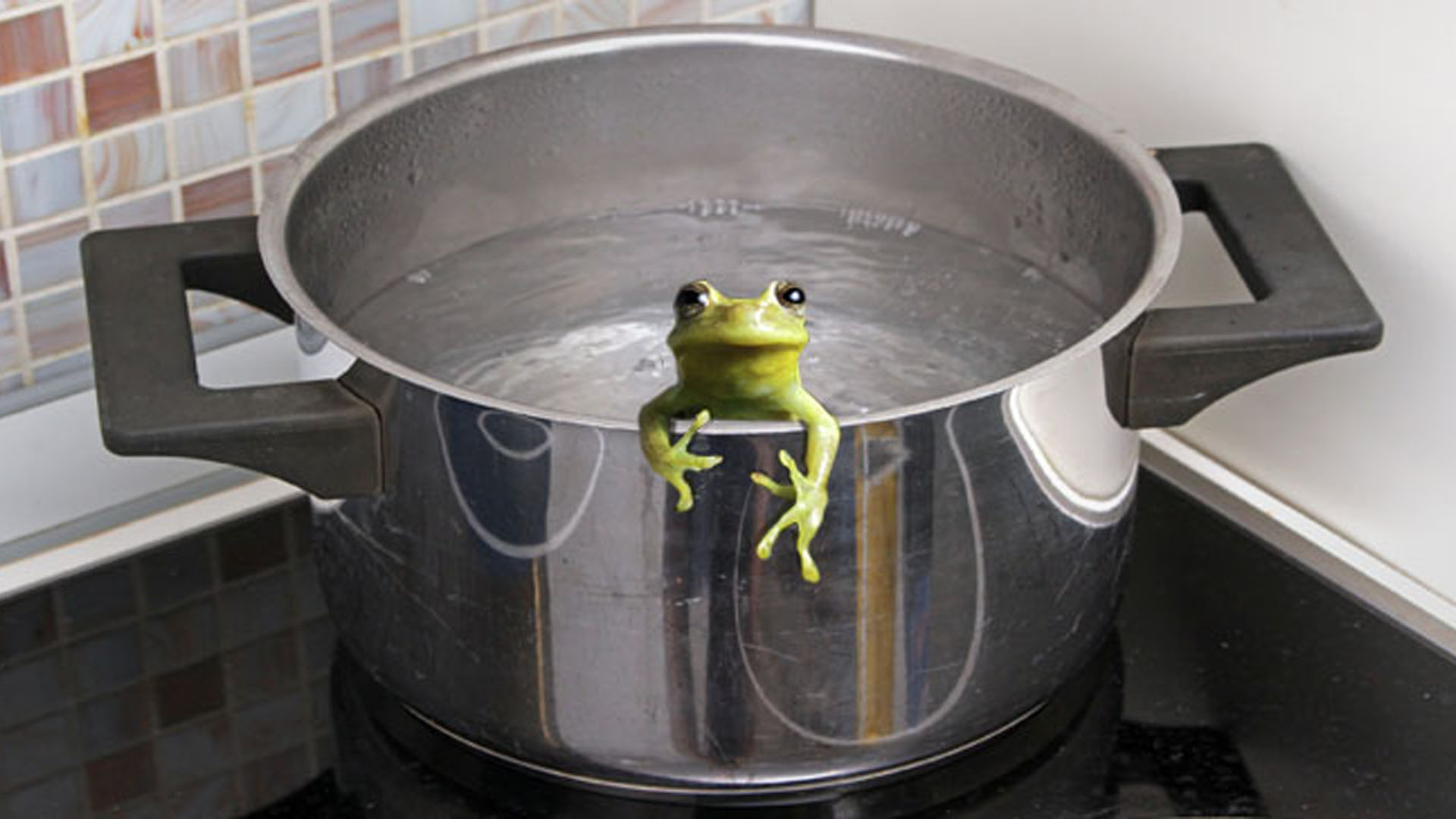
In case you’re not already familiar with it, the Boiling Frog Story is a metaphor for how people are usually slow to react to changes that occur gradually, or to significant events which have become commonplace. Here’s how it goes: If you throw a live frog into a pot of boiling water, it will jump right back out. But frogs are cold-blooded creatures and naturally adjust to gradual changes in the temperature of their environment. So if you place that same frog into a pan of cold water, light the burner on your stove and slowly bring the water up to a boil, the frog will be content to stay in the water until it slowly boils to death. Whether this account is scientifically accurate or just an urban myth, it’s still useful for trying to understand human behavior. 

When it comes to climate change, we are the frog in the story–at least so far. The problem is that we don’t recognize climate change, as profound as it is, as an immediate threat. Our survival instincts are geared towards detecting sudden changes, not gradual developments. So while most of us would agree that we’ve got a problem on our hands, we don’t perceive it as something we need to deal with today, or even next week or next month. So maybe the most important question here is not really “Is this something we need to take action on?”  Maybe a better question is, “Do we need to do it right now?” Our perception of time–not just the facts or the stories we tell–is often the driving force when trying to change minds and move people to take action.

On the other hand, the coronavirus pandemic has certainly gotten our attention.  The pandemic easily fits the definition of an “event for change”–it’s a shared experience that has moved millions of people to make significant changes in the way they live their lives. The fear of immediate danger is the most powerful motivating force in human behavior. Not so much with climate change, though. We may be concerned, but so far we’re not alarmed enough to take bold action. 

coronavirus climate change tweet

I know, I know…many of us have already taken at least a few small steps in the right direction. As comedian/podcaster Marc Maron points out in his recent Netflix comedy special, maybe the reason we’re not more upset about the collapse of the environment is that, deep in our hearts, we know we’ve done everything we can. After all, we started bringing our own bags to the supermarket! And now there’s a movement to do without plastic straws in our take-out beverages.  But the truth is that for most of us, just like that frog in the pot of water, we make a few minor adjustments but otherwise just sit around while things get hotter and hotter. And I know this to be true because I see myself doing it, too. When it comes to climate change, what will need to happen to get most of us to jump out of the water, with as much force as our response to COVID-19? 

The coronavirus pandemic can act as a wake-up call, an event that inspires change. When the pandemic begins to recede, do you see your life going back to pretty much the way it has been in the past? Will you slip right back into that same pot of rapidly heating water we’ve all been soaking in? Or is there a different way of being, changes you can make that will aid in remedying the healing of our environment as well as our community of humans?  

I’ve been struggling with the answer to these questions myself and I know that many others are, as well. So far I’m still just getting started. My partner and I bought into a community solar array a couple of years ago that now produces most of the electricity for our home. We’ve been composting for years. The next time I buy a car, I’m committed to making it an electric vehicle. And I’m writing this blog post, in the hopes that it will get a few more people to think more about how they can start making the jump in their own lives. But none of this comes close to the lifestyle changes I have made due to the coronavirus, and I did all of that in a couple of weeks.

I’ve been looking for advice on what other actions I can take that will make more of a difference. There are plenty of constructive ideas on the Internet, but here’s a great  article from the David Suzuki Foundation that I found helpful and concise:

>>  10 Ways You Can Stop Climate Change

Beyond making changes in our own lives, it’s really important to talk to lots of other “frogs” about this. In the next week, you can email or call your city, state and US representatives to ask them what specific actions they are taking to address climate change. They are the ones who can make a huge impact on the system level, and you’re the one who can make sure they know this is a high priority, right now. Start conversations with your friends and participate on social media. Share ideas and spread the word about what you’re doing and what you see others doing. Just like in the Starfish Story, we can all make a big impact. But we need to start right away.


climate change treeWhew–in the time it just took you to read this article, I could swear it got just a little bit warmer in here.
What ideas do you have about how to help get us all out of hot water? Feel free to add your thoughts below.


Related Post:
Changing Course: How America Got Lost, and How We Can Find Our Way Back Together


Baby Boomers: Time to listen more, talk less

This was the headline at NPR.org, 4 days before the 2016 US Presidential election: “Polarization And A Lack Of Productivity Are Likely To Reign After Election Day”. The article stated that, “with no clear mandate likely coming out of 2016, there is little reason to be overly optimistic that the next Congress can escape the cycle of unproductivity and polarization that has gripped Washington in recent years.”

I can’t say for sure exactly how we got here, but I have noticed that as the Baby Boom generation assumed more and more control of the direction of our country, we have become increasingly polarized as a nation. Maybe that shouldn’t be a surprise. The Boomers emerged on the scene in the 60s and 70s and from the get-go, part of their generational personality has been to divide the world into “us and them”.  You’re either Democrat or Republican. Liberal or Conservative. Pro-life or Pro-choice. You’re expected to choose a side and then dig in and fight, believing that if you shout loud enough and long enough and carry lots of big signs, eventually the folks on the other side will magically change over to your way of thinking. Because after all, we’re “right” and they’re “wrong”. Compromise? That’s seen as a weakness.

Full disclosure: I’m a Baby Boomer myself. I hate to say it, but I’ve actually become embarrassed by my own generation. As a group, we’re really not very good at trying to understand people who see and experience things differently than we do. The Trump & Hillary campaign made that even more painfully obvious. It’s no wonder that, together, we have elected a completely dysfunctional congress—and the result has been gridlock. There are signs that members of the younger generations, particularly the Millennials, haven’t learned to think in such a polarized way.  My hope is that as more Millennials and Xers gain influence, a more collaborative approach will emerge. Until that plays out, there is little evidence to suggest that things will improve.

But nlisten-moreow that the campaign circus has finally left town, we all have a choice to make: we can go even deeper into our corners and fight even harder with each other, or we can go out of our way to really listen to the people who appear to think so differently than we do, to try to understand why they have come to feel that way, and to seek constructive, inclusive solutions. Doubling down and fighting even harder won’t accomplish anything more than hardening the us vs. them paradigm even more than it already is. We should have learned that by now.

Over the course of the campaign, I was struck with how many times I heard people on both sides of the political spectrum say, “How could anyone possibly vote for her/him?” It wasn’t just that people disagreed; it was that they literally couldn’t imagine where the other side was coming from. There is something very important here: the power to change hearts and minds doesn’t start by insisting that you have all the right answers. Instead, it starts with seeking to understand the hopes and fears of the people who, on the surface anyway, are on the opposite side. No, you may not ever agree on the best methods to get results, but my guess is that if you ask honest questions and really listen to the answers, you’ll find that we aren’t really that far apart after all. In the months and years ahead, I’ll be looking for opportunities to do just that. I hope you will, too.


Related Post:
Changing Course: How America Got Lost, and How We Can Find Our Way Back Together